Automated Access Management Workflows for 2026
You've managed CAPTCHAs, turned proxies, and spoofed your User-Agent. Your scraper still gets blocked. Why? Due to the fact that contemporary anti-bot systems don't rely on a single detection approach. They stack numerous layers and you require to comprehend all of them to develop a scraper that survives in production. This guide maps out every detection strategy websites use today, from basic to advanced.
Let's go through them all. Anti-bot services keep databases of recognized bad IPs: import httpx def check_ip_reputation(ip: str) -> dict: """Check if an IP is flagged in common databases.""" checks = # AbuseIPDB resp = ("", params= "ipAddress": ip, headers= "Secret": ABUSEIPDB_KEY ). json() checks [" abuse_score"] = resp [" information"] [" abuseConfidenceScore"] # Examine if datacenter IP checks [" is_datacenter"] = is_datacenter_ip(ip) return checks def is_datacenter_ip(ip: str) -> bool: """Examine if IP comes from a recognized hosting service provider.""" import ipaddress DATACENTER_RANGES = [" 13.0.0.0/ 8", # AWS "34.0.0.0/ 8", # GCP "40.0.0.0/ 8", # Azure "104.16.0.0/ 12", # Cloudflare "157.240.0.0/ 16", # Meta] addr = ipaddress.ip _ address(ip) return any( addr in ipaddress.ip _ network(cidr) for cidr in DATACENTER_RANGES) Go into fullscreen mode Exit fullscreen mode Usage domestic proxies for sensitive targets Rotate IPs from various subnets Prevent datacenter IPs for websites with rigorous anti-bot Sites examine your IP's Autonomous System Number (ASN) to determine hosting suppliers: # What anti-bot services see: # AS7922 (Comcast) Residential # AS7018 (AT&T) Residential # AS16509 (Amazon/AWS) Datacenter # AS14061 (DigitalOcean) Datacenter # AS13335 (Cloudflare) CDN/VPN Enter fullscreen mode Exit fullscreen mode Every HTTP customer has a distinct TLS handshake signature: # Various customers, various fingerprints: # Chrome 121: JA3 = 771,4865-4866-4867-49195 ...
curl: JA3 = 771,4865-4867-4866-49195 ... # Solution: curl_cffi mimics internet browser TLS from curl_cffi import demands resp = ("", impersonate="chrome120") # Now your JA3 matches Chrome 120 precisely Get in fullscreen mode Exit fullscreen mode Browsers send headers in a particular order. Python libraries don't: # Chrome sends: # Host, Connection, sec-ch-ua, sec-ch-ua-mobile, # sec-ch-ua-platform, Upgrade-Insecure-Requests, # User-Agent, Accept, Sec-Fetch-Site ...

Fix: use OrderedDict or curl_cffi headers = "Host": "", "Connection": "keep-alive", "sec-ch-ua": '"Chromium"; v="121"', "sec-ch-ua-mobile": "? 0", "sec-ch-ua-platform": '"Windows"', "Upgrade-Insecure-Requests": "1", "User-Agent": "Mozilla/5.0 ...", "Accept": "text/html, ...", Enter fullscreen mode Exit fullscreen mode HTTP/2 settings (SETTINGS frame, WINDOW_UPDATE, TOP PRIORITY) also develop a special finger print: # Chrome's HTTP/2 settings: # HEADER_TABLE_SIZE: 65536 # MAX_CONCURRENT_STREAMS: 1000 # INITIAL_WINDOW_SIZE: 6291456 # MAX_HEADER_LIST_SIZE: 262144 # Python's default: different values # Detectable # curl_cffi manages this instantly # when you utilize impersonate="chrome120" Get in fullscreen mode Exit fullscreen mode Sites render concealed canvas components and hash the outcome:// What anti-bot JS does: const canvas = document.createElement('canvas'); const ctx = canvas.getContext('2d'); ctx.textBaseline="leading";="14px Arial"; ctx.fillText("Hi, world!", 2, 2); const hash = canvas.toDataURL(). hashCode();// Various GPUs/drivers = various hash Get in fullscreen mode Exit fullscreen mode const gl = canvas.getContext('webgl'); const debugInfo = gl.getExtension( 'WEBGL_debug_renderer_info' );// Genuine internet browser: gl.getParameter(debugInfo.
Strategies for Scale Global Resources with Automation
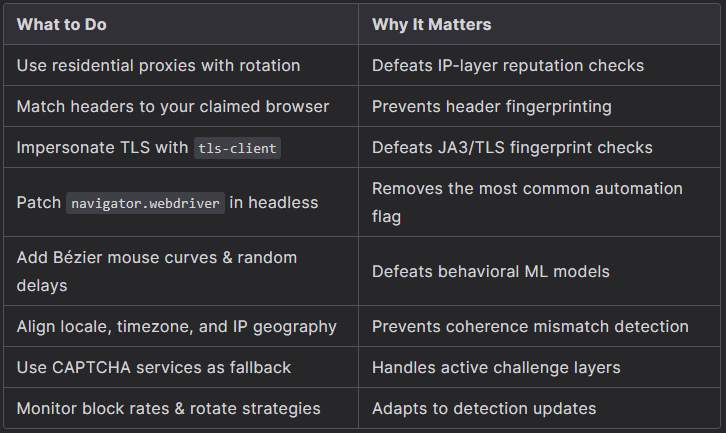
Most scrapers get blocked at layers 3-4, not 5-7. repairing one layer while overlooking others won't work these catch 55% of bots before JS even runs but they're set off by invisible signals mouse movement and timing matter more each year use bot detection sites to examine your setup even perfect stealth can't avoid all obstacles For handling the CAPTCHA layer when it activates, have a look at passxapi-python it offers a unified API for reCAPTCHA, hCaptcha, Turnstile, and FunCaptcha, so you can concentrate on the other layers.
In this tutorial, you will discover the following: What Cloudflare is. Top-level methods to bypass Cloudflare. How to bypass the Cloudflare human check in Python.
Xrumer softwareIt provides a comprehensive suite of services created to make websites quicker and more secure., caching website material on a worldwide network to enhance load times and lower latency.
Optimizing Network Operations for Enterprise Automation
By integrating with Cloudflare's network, sites can rapidly get improved security and enhanced performance. This can be allowed on any web page served through its international network.
More specifically, the Cloudflare WAF sits in front of your web applications. It examines and filters incoming requests in genuine time to stop attacks or unwanted traffic before they reach your servers or access your web pages. As part of its multilayered defense strategy, the Cloudflare WAF utilizes proprietary algorithms to identify and block malicious bots.
It looks at details like the cipher suites used, the order of settlement, and other low-level traits. Bots frequently reuse default or suspicious configurations that differ from those utilized by real web browsers.
This consists of the specific internet browser version, operating system, installed fonts or extensions, and even subtle hardware qualities. These information points form a fingerprint that assists distinguish real users from automated scripts.: One of the strongest signs of automated traffic is unnatural habits. Cloudflare screens patterns like fast requests, absence of mouse motions, identical click courses, idle times, and more.
This is one of the most complex anti-bot strategies. Cloudflare typically offers two modes of human confirmation: Always show the human verification difficulty Automated human verification challenge (just when suspicious activity is found) Check out both alternatives listed below! The first mode is less typical however offers stronger protection. The idea is to constantly require human confirmation on the first access to a site.
Xrumer softwareCybersecurity Predictions and Expect in 2026
Attempt visiting it in incognito mode (to make sure a fresh session with no cookies), and you will see a CAPTCHA called Cloudflare Gate, even if you are a genuine human user:: By the time you read this post, StackOverflow's bot defense might have changed or be working differently. In this case, if you are building an automated script, the only choice is to automate the Turnstile CAPTCHA interaction in a human-like method.
In this mode, Cloudflare only issues an obstacle if it presumes a request may be from a bot., which runs invisibly in the web browser to validate that the client behaves like a genuine user: This process is smooth and typically finishes immediately if you are a human utilizing a regular browser.
Since this causes minimal disturbance for regular users, it is by far the most typical Cloudflare mode. Nevertheless, if the JavaScript challenge fails (significance Cloudflare concludes the customer is likely to be a bot), it will escalate to revealing a Turnstile CAPTCHA for human verification: Now, you are back to what you saw in the previous scenario.
Scaling Global Workloads for Enterprise Infrastructure
Still, if it does appear, you require a method to deal with it. Attempt opening the NopeCHA Cloudflare test page in incognito mode utilizing your browser. This page is safeguarded by the Cloudflare WAF, so the automated JavaScript-based confirmation procedure will right away begin. In the background, a series of POST demands are exchanged with Cloudflare's endpoints, transmitting encrypted information within their payloads: The exact contents of these payloads are not openly recorded.












